October 2026

NEWA Hosts UN Trust Fund Mission to Review Progress in Strengthening SGBV Responses in Ethiopia

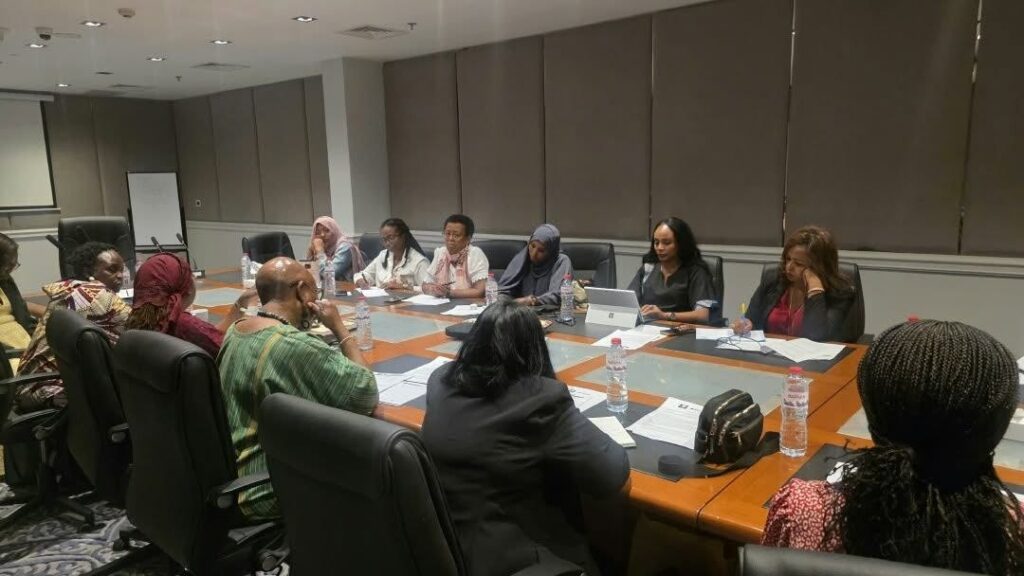
NEWA Hosts UN Trust Fund Mission to Review Progress in Strengthening SGBV Responses in Ethiopia On October 20, 2026, the Network of Ethiopian Women’s Associations (NEWA) hosted a mission team from the UN Trust Fund to End Violence against Women (UNTF), alongside its regional implementing partners: Besa for Women Community-Based Development Association, Mujejeguwa Loka Women Development Association (MLWDA), and Rise and Shine Women Empowerment Center.The mission provided an opportunity to review the first year’s progress and achievements under the four-year project, “Improving Legal and Service Responses to Sexual and Gender-Based Violence (SGBV) in Conflict-Affected Areas of Ethiopia.” NEWA presented the project progress report, highlighting key achievements, implementation challenges, actions taken to address them, and lessons learned to strengthen implementation and improve results.The discussion also featured findings from two assessments: the Baseline Assessment of SGBV Service Delivery in Conflict-Affected Areas and the Assessment of Existing Accountability Mechanisms for Responding to SGBV and Conflict-Related Sexual Violence (CRSV). The findings informed reflections on service delivery gaps, the needs and priorities of women and girls, and opportunities to strengthen survivor-centred services and institutional accountability.NEWA sincerely appreciates the mission team’s constructive technical feedback, valuable insights, and continued partnership. We also recognize the dedication of our regional implementing partners, whose collaboration and field experience are vital to learning, adapting, and improving responses to SGBV.Together, we remain committed to advancing accessible, accountable, and survivor-centred services for women and girls affected by violence.The project is implemented at the federal level and in Amhara, Benishangul-Gumuz, and Tigray regions, with financial support from the UN Trust Fund to End Violence against Women.#NEWA #UNTrustFund #EndViolenceAgainstWomen #SGBV #CRSV #Accountability #SurvivorCentredResponse 000000000 00000000 0000000 0Q6A0635 0Q6A0643 0Q6A0658 0Q6A0664 0Q6A0671 0Q6A0681 0Q6A0686 Load More End of Content.

NEWA Hosts UN Trust Fund Mission to Review Progress in Strengthening SGBV Responses in Ethiopia Read More »

SUCCESSFULLY CONCLUDED: COMMUNITY AWARENESS-RAISING CAMPAIGN ON ENDING FGM AND CHILD MARRIAGE

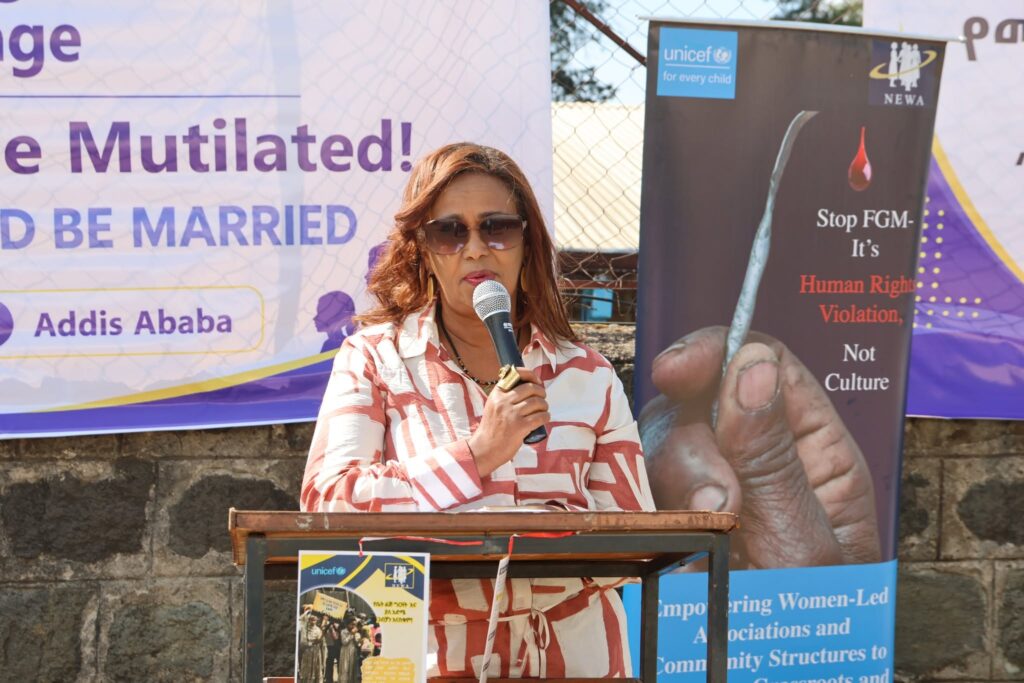
SUCCESSFULLY CONCLUDED: COMMUNITY AWARENESS-RAISING CAMPAIGN ON ENDING FGM AND CHILD MARRIAGE Addis Ketema Senior Secondary School, Addis Ababa, Ethiopia | 17 October 2026The Network of Ethiopian Women’s Associations (NEWA), in partnership with UNICEF, successfully hosted a city-wide Community Awareness-Raising Campaign focused on ending Female Genital Mutilation (FGM) and Child Marriage (CM). The event convened over 250 key stakeholders representing all sub-cities across Addis Ababa.Diverse Stakeholder Representation: The campaign brought together a broad coalition of community leaders and institutions, including:Government representatives and civil society organizations (CSOs)Women-led organizations and former women firewood carriers’ associations; Community-Based Organizations (CBOs), Iddirs, and Elders’ Associations, School administrations, Parent-Teacher Associations (PTAs), student/teacher associations, and Girls’ Clubs.Panel Discussion: Sustaining Efforts to End FGM and Child Marriage. A central feature of the campaign was an interactive panel discussion that actively engaged representatives from across the participating groups. Panelists and audience members explored practical, community-led strategies to sustain momentum and drive long-term behavioral change beyond initial awareness efforts.Key themes included:Community Ownership: Strengthening grassroots leadership and engaging traditional and religious leaders as advocates for change.Empowerment & Education: Advancing girls’ education and challenging deeply entrenched social norms that undermine women’s rights.Multi-Sectoral Collaboration: Enhancing coordination among government institutions, schools, civil society, and traditional community structures.The discussion highlighted the alignment of these local efforts with the United Nations Sustainable Development Goals (SDGs)—specifically SDG 3 (Good Health and Well-being), SDG 4 (Quality Education), SDG 5 (Gender Equality), and SDG 16 (Peace, Justice, and Strong Institutions).Drama & Music: Inspiring Change Through Art. The event integrated creative drama and music performances designed to convey the physical, psychological, and social impacts of FGM and child marriage. Through culturally relevant storytelling and artistic expression, the performances prompted reflection on harmful practices while reinforcing the shared responsibility of families and communities to protect young girls.By combining artistic expression with structured dialogue, the campaign fostered an environment of open reflection and commitment to action.Our Shared Commitment Every girl deserves to grow up free from violence, exploitation, and harmful practices.End FGM!Stop Child Marriage!Ending FGM and child marriage requires continuous commitment, strategic partnerships, and collective responsibility. Together, we are building a future where every girl can realize her rights, dignity, health, and full potential.Empowering Communities. Transforming Futures. 0 855575613_1127573252966715_8335296289161089502_n 855272409_1127573152966725_54010110357469465_n 855272306_1127573116300062_8109273528215867237_n 855086392_1127573009633406_3543994297717915743_n 854911253_1127573196300054_8844335484338050433_n 854911242_1127573232966717_4273939561599747483_n 854855517_1127573292966711_205448249489136303_n 854316174_1127610252963015_9221497862629438409_n 853805361_1127610136296360_5396635733275213399_n Load More End of Content.

SUCCESSFULLY CONCLUDED: COMMUNITY AWARENESS-RAISING CAMPAIGN ON ENDING FGM AND CHILD MARRIAGE Read More »

NEWA Supports Werebabo Safe Space to Strengthen Survivor-Centred Services for Women and Girls

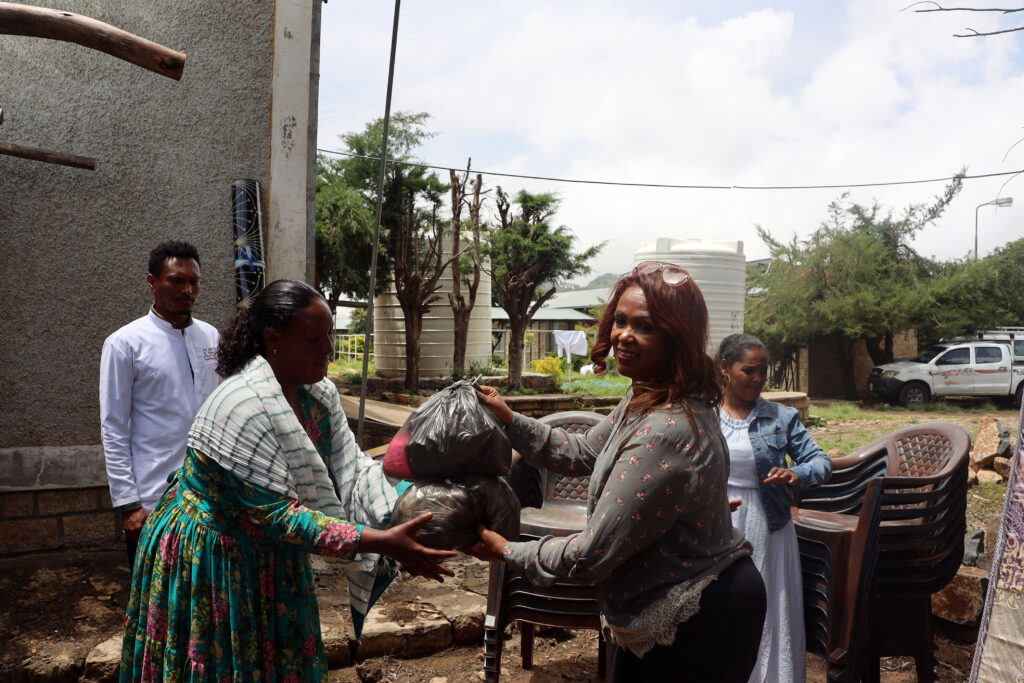
NEWA Supports Werebabo Safe Space to Strengthen Survivor-Centred Services for Women and Girls On September 17, 2026, the Network of Ethiopian Women’s Associations (NEWA), with financial support from the United Nations Trust Fund to End Violence against Women (UNTF), provided demand-driven material support to the women and girls’ safe space in Werebabo, South Wollo Zone, to improve the delivery of survivor-centred services. The support aims to create a more comfortable, confidential and welcoming environment where survivors can access psychosocial support, participate in healing sessions, build self-esteem and resilience, and strengthen their ability to cope with the effects of violence and reintegrate into their communities. The materials provided include a television and accessories, mat, mattresses, blankets, bed sheets, pillow, chairs, tables, first-aid kits, sanitary pads, traditional Ethiopian coffee-making equipment, and a lockable filing cabinet to ensure the confidential storage of survivors’ records, alongside other essential supplies. By strengthening the safe space’s facilities, NEWA seeks to support the provision of dignified, confidential, and survivor-centred services that promote survivors’ well-being, recovery, and resilience. A safe and supportive space is an important step toward healing, rebuilding confidence and restoring hope. 0Q6A0383 0Q6A0373 0Q6A0393 0Q6A0406 0Q6A0391 0Q6A0387 0Q6A0384 0Q6A0379 0Q6A0378 0Q6A0363 Load More End of Content.

NEWA Supports Werebabo Safe Space to Strengthen Survivor-Centred Services for Women and Girls Read More »

Experience Sharing to Strengthen Women’s Role in Peacebuilding

Experience Sharing to Strengthen Women’s Role in Peacebuilding On the margins of the 8th GIMAC Network CSOs–RECs Coordination Meeting, the Network of Ethiopian Women’s Associations (NEWA) and the Ethiopian Women’s Peace Table, in partnership with ACCORD and with financial support from the Government of Ireland, brought women #peacebuilders together for an experience-sharing and learning exchange on what it takes to sustain women’s meaningful participation in peace processes.The exchange provided a valuable space for women peacebuilders to share experiences, reflect on lessons learned, identify practices that can be adapted and carried forward, and discuss challenges that require collective attention. Sharing experiences. Building solidarity. Sustaining women’s meaningful participation in peace. 831492650_1112458461144861_1272997360405090867_n 830349655_1112458394478201_251635079733272888_n 828710998_1112458351144872_5428050069828368624_n 830572522_1112458367811537_5802318946462283958_n 828443430_1112456574478383_6684417977979809436_n 829631424_1112456701145037_3870918030308294653_n 830594075_1112456357811738_280737467107781252_n 830669032_1112456874478353_3763254192538750947_n 833862495_1112455277811846_3741522389714431480_n

Experience Sharing to Strengthen Women’s Role in Peacebuilding Read More »

Stakeholders Co-Create Practical Solutions to Reduce Unpaid Care and Domestic Work in Addis Ababa and Oromia

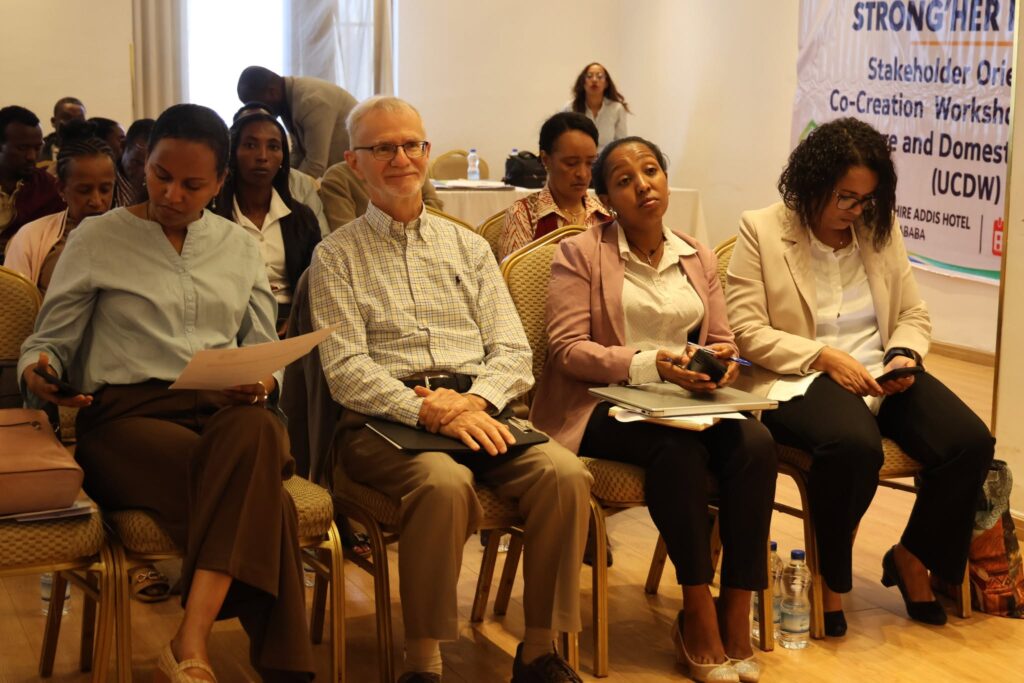
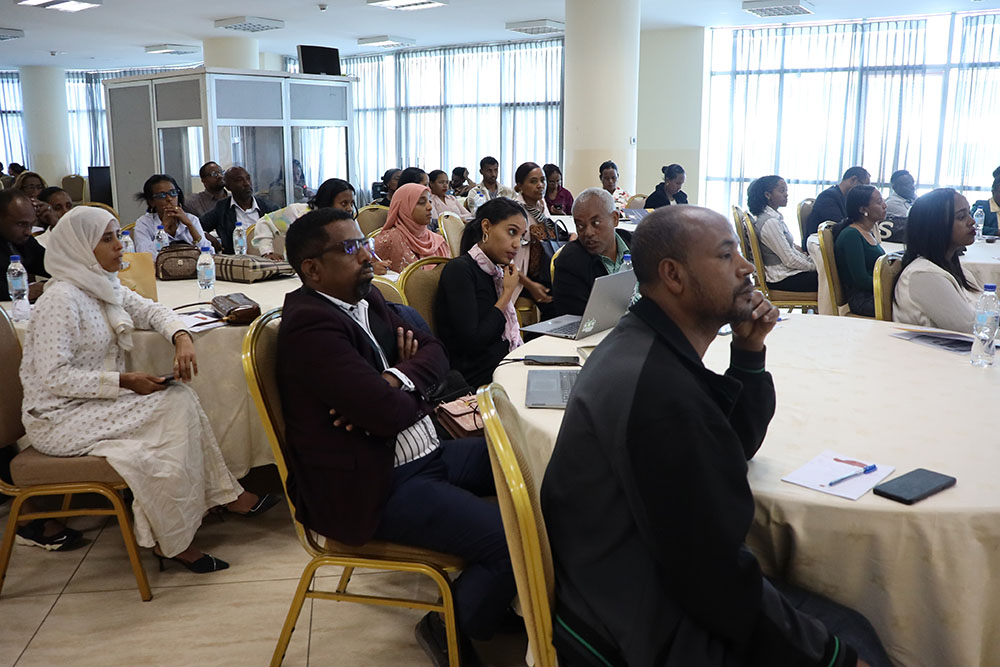
Stakeholders Co-Create Practical Solutions to Reduce Unpaid Care and Domestic Work in Addis Ababa and Oromia Addis Ababa, Ethiopia | 29–30 September 2026A two-day participatory workshop on Unpaid Care and Domestic Work (UCDW) successfully convened 71 participants at the Sapphire Addis Hotel in Addis Ababa on 29–30 September 2026. Organized jointly by the Network of Ethiopian Women’s Associations (NEWA) and SOCODEVI under the STRONG’HER Project, the workshop served as a vital collaborative platform to identify practical, locally driven solutions for reducing the heavy time and labor burdens that unpaid care and domestic responsibilities place on women and families. The workshop brought together a diverse group of key stakeholders representing regional governance, grassroots communities, and national development partners: Local Administrations and Woredas: Representatives from five target woredas—Lume, Ambo, Ejere, Wolmera, and Toke Kutaye—alongside Addis Ababa City Administration bureaus. Government Ministries: Delegates from the Ministry of Agriculture (MoA) and the Ministry of Women and Social Affairs (MoWSA). Civil Society and Cooperatives: NEWA, SOCODEVI, the STRONG’HER Project, ERSHA, Melka Ethiopia, the Ambo Farmers’ Union, and the Lume-Adama Farmers’ Union. Designed as an action-oriented platform, the event deliberately moved beyond discussing the challenges of UCDW toward identifying feasible interventions, clear institutional responsibilities, and practical actions implementable at both woreda and sector levels. Opening and Welcome Remarks The event commenced with welcoming remarks delivered by Yididya Abebe on behalf of Wro. Saba G/Medhin, Executive Directress of NEWA. The address welcomed attendees, outlined the core workshop objectives, and emphasized the critical necessity of collective action to ease the care burden. Opening remarks were also delivered by SOCODEVI Country Director Mario Boivin, who highlighted SOCODEVI’s work in partnership with Global Affairs Canada, underscored the strong collaboration behind the STRONG’HER Project, and stressed the urgency of transforming shared understandings into concrete, localized interventions. Technical Foundations: From Understanding the Burden to Identifying Solutions The technical sessions opened with an introduction to the SOCODEVI STRONG’HER Project by SOCODEVI Deputy Directress Alemtsehay Ejigu, who framed the initiative’s overarching goals for women’s economic empowerment. NEWA Program Officer Desalegn Terecha Edea then led a comprehensive session on UCDW and the 5Rs Framework (Recognize, Reduce, Redistribute, Reward, and Represent). Presenting localized time-poverty data from Addis Ababa and the five woredas, the session vividly demonstrated how unpaid care obligations restrict women’s access to economic and social opportunities. A lively question-and-answer session followed. Collaborative Time-Use Diary ExerciseFacilitated by the joint NEWA and SOCODEVI team, participants engaged in a hands-on time-use diary exercise. This comparative analysis mapped out how household and care responsibilities are distributed across urban, peri-urban, and agrarian settings, highlighting stark gender disparities and pinpointing where the heaviest household burdens lie. Breakout Sessions and Leverage Point MappingOrganized into dedicated woreda and sector groups, participants mapped critical leverage points influencing the distribution of unpaid care work: Water Access and Infrastructure: Evaluating collection times and service reliability.Energy Alternatives: Expanding improved cooking technologies to minimize domestic labor.gricultural Innovations: Introducing labour-saving equipment, such as threshers, to ease agricultural workloads.Childcare and Community Services: Exploring early childhood care and education frameworks. Institutional Support: Integrating Health Extension Workers (HEWs) and strengthening municipal backing. Social Norms: Fostering men’s participation and community-based support systems. A robust plenary synthesis—facilitated to bridge community needs with institutional capabilities. Discussions rigorously evaluated proposed interventions by addressing feasibility, piloting potential, long-term ownership, maintenance, financing, accountability, and scalability. Co-Creating Woreda and Sector-Level Actions Day two shifted the focus decisively from analysis to actionable strategy. Working in thematic and geographic groups, participants designed contextualized solutions: Ambo, Toke Kutaye, Wolmera, and Ejere: Focused on labour-saving agricultural technologies and enhanced peri-urban service access. Lume: Designed industrial public-private partnership (PPP) childcare models.Addis Ababa: Formulated robust municipal integration frameworks. Teams refined and costed these low-cost solutions to ensure they could be effectively piloted within the STRONG’HER project budget. Proposals were tied to clear institutional roles, designated beneficiaries, and measurable UCDW indicators. The groups presented their models in a plenary session, receiving structured feedback from regional Bureau of Women, Children and Youth Affairs (BoWCYA) and municipal representatives to cross-pollinate best practices. Rather than developing isolated interventions, participants emphasized how government bodies, communities, service providers, farmers’ organizations, and civil society must unite to build sustainable solutions. Turning Ideas into 90-Day ActionA defining hallmark of the workshop was its commitment to practical, time-bound execution. Rather than remaining static recommendations, the action-planning process established concrete 90-day steps across water access, clean energy, climate-resilient agricultural technologies, childcare services, and institutional coordination. This approach ensures that proposed interventions evolve into locally owned actions backed by solid partnerships, defined implementation responsibilities, and measurable results. Strengthening Collaboration for ChangeThe multi-sectoral participation of government institutions, woredas, farmers’ unions, civil society, and development partners demonstrated that reducing UCDW requires coordinated action across infrastructure, agriculture, energy, childcare, local governance, social norms, and community systems rather than a single isolated intervention. The workshop concluded by the closing remark of Senait Endale, SOCODEVI GENDER SPECIALIST with an evaluation, final reflections, and official closing remarks by NEWA and SOCODEVI leadership, following the formal adoption of monitoring indicators and institutional roles for the upcoming pilot phases. The journey from dialogue to action has truly begun—driven by locally identified priorities, practical solutions, and stronger institutional partnerships among the communities and institutions that can make change happen.#CoCreation #LocalAction #InclusiveDevelopment #SocialTransformation 838698932_1116324904091550_5046832609111388550_n 838698930_1116324890758218_3186245891257550459_n 837494599_1116324980758209_5796674969440585450_n 837061145_1116324947424879_868268810508595924_n 835757052_1116324804091560_9213804483743069581_n 835640453_1116324914091549_5650524620146733827_n 833895199_1116324854091555_1845880858450391427_n 833779827_1116324857424888_1649095511384022824_n

Stakeholders Co-Create Practical Solutions to Reduce Unpaid Care and Domestic Work in Addis Ababa and Oromia Read More »